Advertisement
Involving Providers in the Decisions that Affect Them
Involving Providers in the Decisions that Affect Them
An interview with Jill Powelson, DrPH, MPH, MBA, RN, CPC, CPPM, Vice President, AMGA Consulting
Provider dissatisfaction and organizational misalignment are creating unprecedented challenges in healthcare delivery. Over 80% of providers feel they lack influence in organizational decision making, and the answer isn’t better messaging from leadership. Instead, it is a structured, co-created agreement that resets expectations from both sides. A ProPact (Provider-Organization Compact) is a written document developed collaboratively by providers and their organization’s leaders that delineates responsibilities and reciprocal expectations. Hear from AMGA Consulting vice president Jill Powelson, DrPH, MPH, MBA, RN, CPC, CPPM, on how a ProPact reflects true collaboration.
-
Can you explain what a ProPact is and how it differs from a traditional top-down directive or employment contract?
I’ll start with the second part of your question. We know as leaders that issuing top-down directives is not ideal for building engagement with professionals. So I would encourage organizational leaders to avoid that approach whenever possible. And an employment contract is, well, a contract. It is typically written by lawyers and includes specific legal language.
What is typically not spelled out well in a contract are other important key points: How does the organization support providers in their day-to-day work? What is expected of providers? How are providers and the organization going to work together effectively? A ProPact is a written agreement between the organization and its providers created collaboratively by a team over several months. It fills in these gray areas, providing clarity and building a strong foundation for a trusting and productive relationship.
-
What tensions can arise when the traditional implicit compact that providers have historically operated under collides with modern healthcare’s push for standardization and efficiency—and how does a ProPact help address those tensions?
Many providers were trained to be independent and decisive. A provider may reasonably assume that when they join an organization, the organization will allow them to practice as they see fit. Providers can be understandably upset when initiatives are launched that tell them what they must do differently (see above comment about top-down directives).
A best practice is to evolve from an implicit compact to an explicit one by developing a ProPact—a written compact—accompanied by fair processes that seek provider input on the decisions that impact them the most. In other words, providers should be involved in decisions that affect them.
-
Who are the key stakeholders involved in developing a ProPact, and why is it important that both providers and organizational leaders participate in the process?
Hopefully it would go without saying, but the providers should be involved! They participate in listening sessions, surveys, interviews, etc. Administrative stakeholders should also actively participate. We recommend forming a committee of providers and administration that meets regularly to talk through the details of the ProPact.
Sometimes questions come up about health system leadership – if they are actively involved in medical group decisions, which many times they are, then they should absolutely be at the table.
-
What does “reciprocal expectations” mean in the context of a ProPact, and can you give examples of what those expectations might look like from both the provider’s and the organization’s perspective?
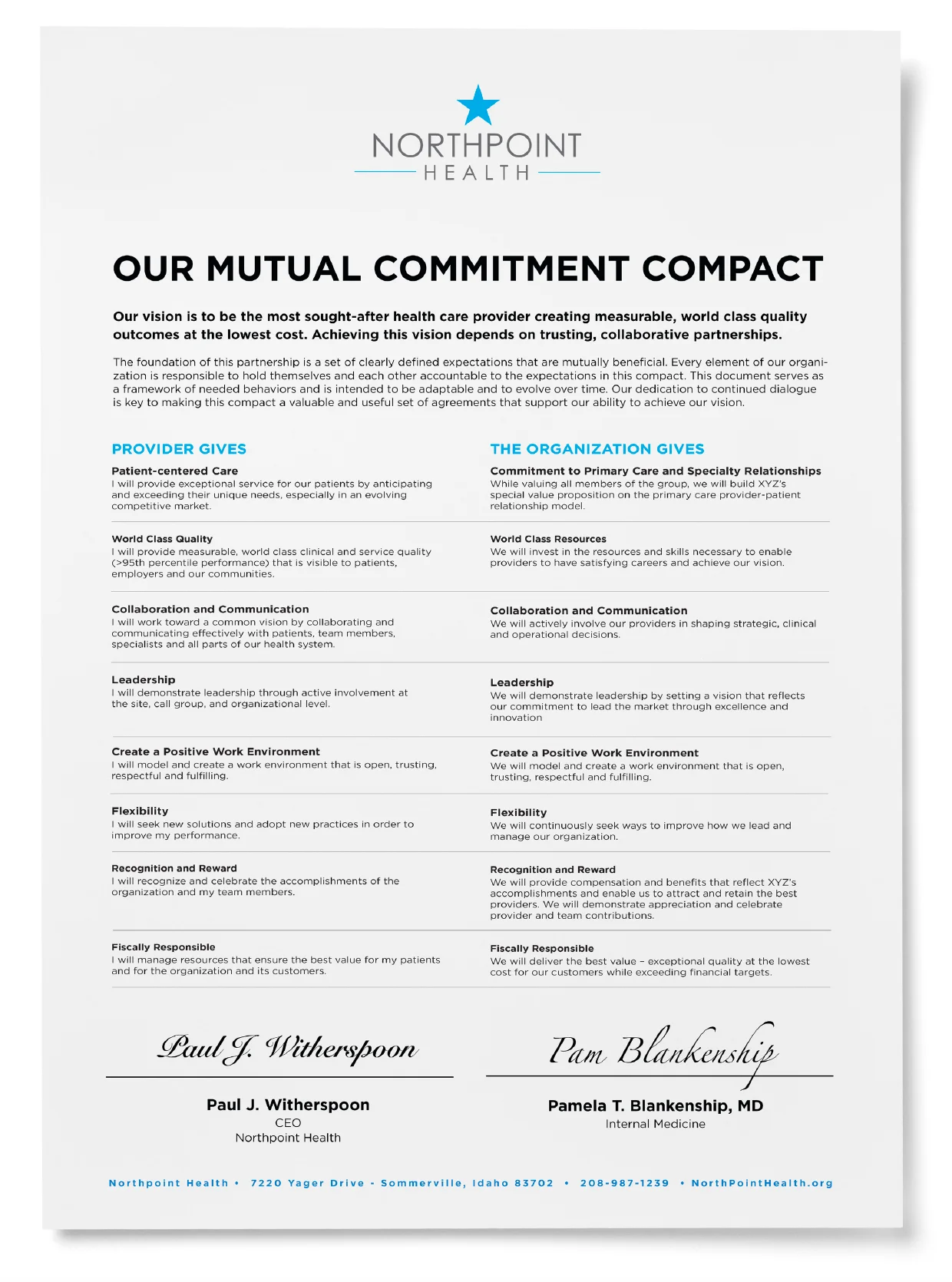
Reciprocal expectations are what each party commits to do and what they expect to receive. These should be customized to each organization, to reflect their culture and their own providers’ and administrators’ perspectives. A sample is provided here.
-
Once a ProPact is in place, how should an organization ensure that the commitments outlined in it are upheld over time by both providers and leaders?
We recommend that the new compact is shared widely within the organization. Share it during the recruitment process and use it as a guideline during annual performance management discussions. Also, monitor and measure provider engagement. It can be helpful to have a baseline measurement then follow up with surveys annually or every other year. Then revisit and evolve the compact as needed, for example, during a 3–5 year strategic planning cycle or as part of an acquisition or merger with another organization.
For questions or additional information, please email Jill Powelson at jpowelson@amgaconsulting.com.